
11
November


I just started reading Elizabeth Smart’s book “My Story” and realized that just like others attacked by psychopaths, there was a clear path that could have prevented or lessoned the horrible plight that these victims went through. Mental health professionals should befriend and/or visit those who have had episodes/experiences that have been shown to lead to a possible path of deviance. If the mental health professionals meet with such individuals on a semi-annually basis they would be able to insure that they weren’t planning or acting in a way that could cause pain or harm to the innocent. Furthermore if they felt there were suspicious activities occurring they could report these actions to the police for further investigation and G-D willing stop or prevent these acts from occurring in the first path.
I sure hope this works because it looks good…. real good.

Click to see the way I’m going to attempt to make Turkey this year.

Before we judge Richie Incognito from the Miami Dolphins I believe it’s important to get his view of the events.
Please click the link below to get his point of view

I was trying to take a break from football today but this game and my “Blue Moon” are drawing me in. It looks like that “Hail Mary” was for not.

Wow what an ending! A Hail Mary pass that makes anyone a believer.

I have lived by the saying “you sometimes have to lose a battle to win a war” but in the past that has led me to a path of avoiding any conflicts (except the written ones). I would be afraid to discuss certain topics because I feared others would “hate me” for my positions. I understand now that those that appear “to hate you” because of a reasonable position are truly hateful people as a whole. I make every effort to be respectful to those that have differing opinions but expect and demand that others do the same as well. Yes there are times you shouldn’t bring up a difficult topic but when your values are challenged it’s time to stand up strong. Yet how do you continue to fight when you feel you’re the last one in the room.
(1) Bring up your point directly and respectfully to others who disagree with you.
(2) Don’t continue an endless debate going know where. If you feel tensions are getting a bit high agree to disagree and move on to a different more peaceful topic.
(3) If the individual(s) brings up the topic when you’re uncomfortable discussing its say “I think we know each others positions on this issue” and bring up a different topic.
The point is to make sure that the battles you might be having with others don’t lead to a war that ends a friendship unless it is truly necessary.
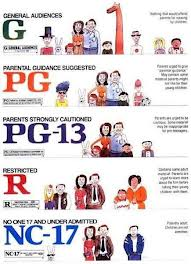
We trust the movie industry to decide on a rating system for films (see below) but we don’t trust other industries to rate or regulate themselves why?
The Motion Picture Association of America, Inc. (MPAA), together with the Motion Picture Association (MPA) and MPAA’s other subsidiaries and affiliates, serves as the voice and advocate of the American motion picture, home video and television industries in the United States and around the world. MPAA’s members are the six major U.S. motion picture studios: Walt Disney Studios Motion Pictures; Paramount Pictures Corporation; Sony Pictures Entertainment Inc.; Twentieth Century Fox Film Corporation; Universal City Studios LLC; and Warner Bros. Entertainment Inc. We are a proud champion of intellectual property rights, free and fair trade, innovative consumer choices, freedom of expression and the enduring power of movies to enrich and enhance people’s lives.
MPAA’s principal U.S. offices are located in Washington, D.C., and Los Angeles, California. We also have content protection teams in Chicago, Dallas and New York. The MPA, and other subsidiaries and affiliates of MPAA, have commercial and regional offices in Brussels, Singapore, Sao Paulo, Mexico City and Toronto. Along with our own subsidiaries and affiliates, we work with many content protection groups and other organizations in more than 30 countries around the world.
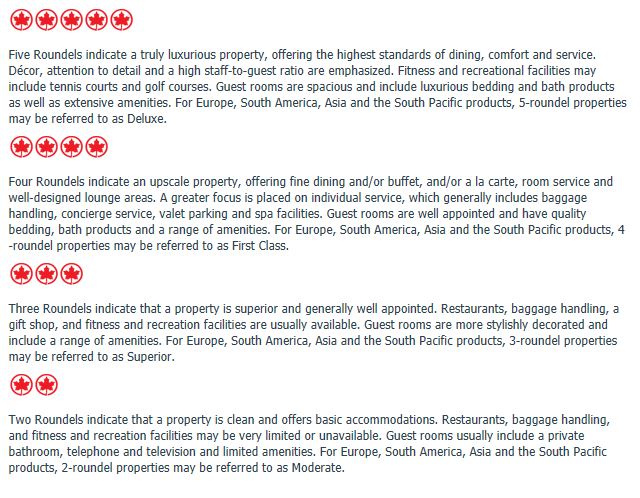
Hotel Ratings are usually determined by private sources not governmental agencies (see below). Yet we trust those ratings so I wonder why we feel such an impetus to have governmental involved in many of our other business activities.
From Wikipedia
Hotel ratings are often used to classify hotels according to their quality. The development of the concept of hotel rating and its associated definitions display strong parallels. From the initial purpose of informing travellers on basic facilities that can be expected, the objectives of hotel rating has expanded into a focus on the hotel experience as a whole.[1] Today the terms ‘grading’, ‘rating’, and ‘classification’ are used to generally refer to the same concept, that is to categorize hotels, mostly using stars as a symbol
There are a wide variety of rating schemes used by different organizations around the world. Many have a system involving stars, with a greater number of stars indicating greater luxury.Forbes Travel Guide, formerly Mobil Travel Guide, launched its star rating system in 1958. The AAA and their affiliated bodies use diamonds instead of stars to express hotel and restaurant ratings levels.
Food services, entertainment, view, room variations such as size and additional amenities, spas and fitness centers, ease of access and location may be considered in establishing a standard. Hotels are independently assessed in traditional systems and rest heavily on the facilities provided. Some consider this disadvantageous to smaller hotels whose quality of accommodation could fall into one class but the lack of an item such as an elevator would prevent it from reaching a higher categorization.[2]
In recent years hotel rating systems have also been criticised by some who argue that the rating criteria for such systems are overly complex and difficult for laypersons to understand. It has been suggested that the lack of a unified global system for rating hotels may also undermine the usability of such schemes.
[hide]
The more common classification systems include “star” rating, letter grading, from “A” to “F”, diamond or simply a “satisfactory” or “unsatisfactory” footnote to accommodation such as hostels and motels. Systems using terms such as Deluxe/Luxury, First Class/Superior, Tourist Class/Standard, and Budget Class/Economy are more widely accepted as hotel types, rather than hotel standards.
Some countries have rating by a single public standard — Belgium, Denmark, Greece, Italy, Malta, Netherlands, Portugal, Spain and Hungary have laws defining the hotel rating. In Germany, Austria and Switzerland, the rating is defined by the respective hotel industryassociation using a five-star system — the German classifications are Tourist (*), Standard (**), Comfort (***), First Class (****) and Luxury (*****), with the mark “Superior” to flag extras beyond the minimum defined in the standard. The Swiss hotel rating was the first non-government formal hotel classification beginning in 1979[3] It did influence the hotel classification in Austria and Germany.[3] The formal hotel classification of the DEHOGA (German Hotel and Restaurant Association) started on August 1, 1996 and proved very successful with 80% of guests citing the hotel stars as the main criteria in hotel selection.[4] This implementation influenced the creation of a common European Hotelstars rating system that started in 2010 (see below).
In France, the rating is defined by the public tourist board of the department using a four-star system (plus “L” for Luxus) which has changed to a five-star system from 2009 on. In South Africa and Namibia, the Tourist Grading Council of South Africa has strict rules for a hotel types granting up to 5 stars.